Architecture

RealGazebo Architecture

Modular Framework

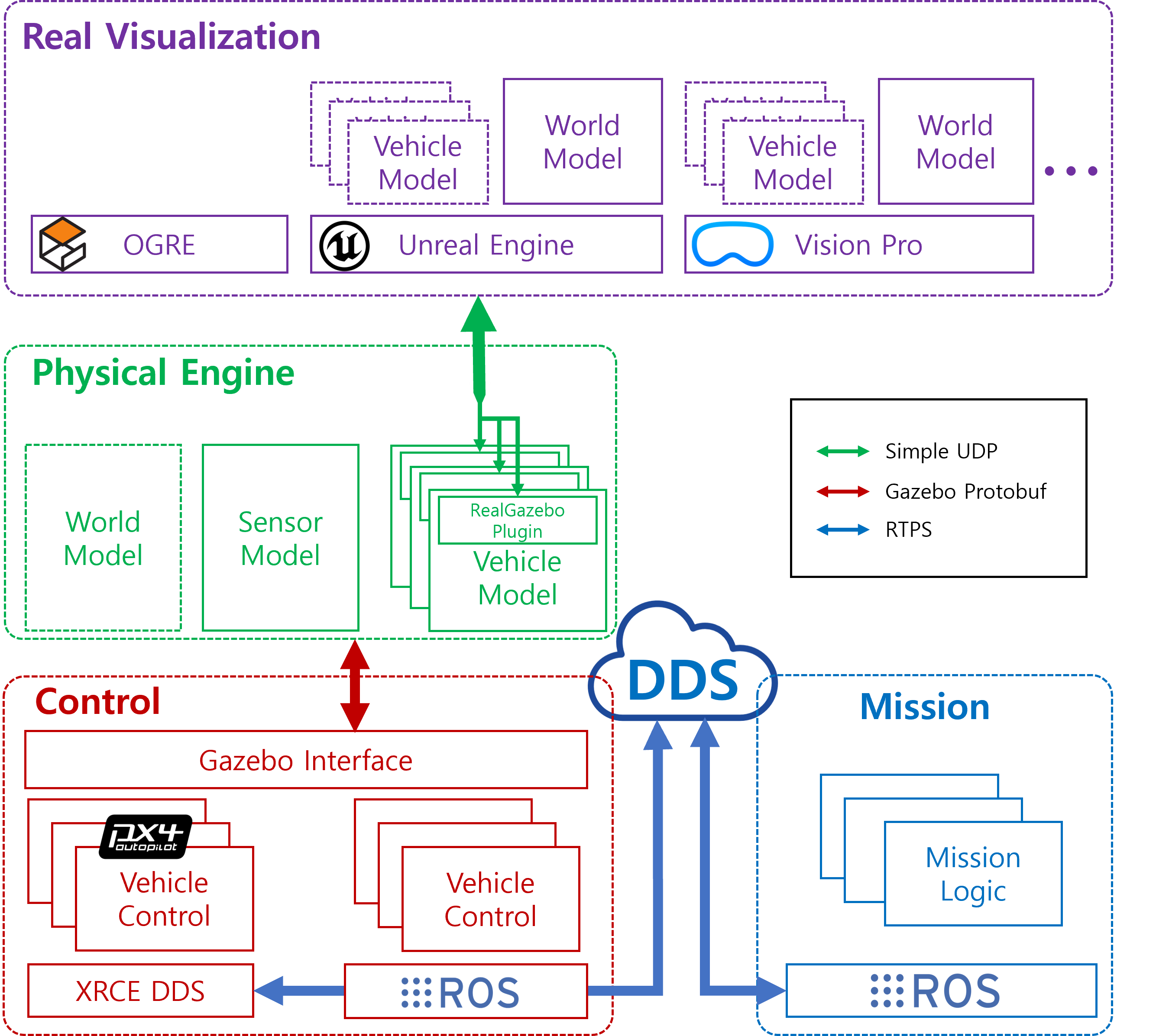
RealGazebo is a flexible simulation framework in which rendering, physics, control, and mission logic are modularized and operated independently. Unlike conventional approaches where all functions are integrated into a single system, each module in RealGazebo can be deployed on separate systems. This modular design enhances scalability, enabling the operation of multiple unmanned vehicles as well as the integration of new technologies.

Physics Engine

For the physics engine, RealGazebo adopts the PX4-ROS2 platform and allows the selection of various physics engines provided within Gazebo. Consequently, users can choose the most suitable physics engine depending on the situation, while leveraging the open ecosystem of Gazebo to reuse existing features without modification. In particular, sensor plugins provided by hardware manufacturers can be seamlessly integrated, enabling diverse experimental scenarios.

Control Component

For the control component, PX4 controllers are employed by default. However, the internal interface allows integration with the physics engine and data sharing through DDS, which ensures compatibility with various control algorithms regardless of programming language dependencies.

Rendering Engine

For the rendering engine, RealGazebo primarily employs OGRE-based rendering from Gazebo. When higher photorealism is required, Unreal Engine can be used, and additional visualization devices such as Apple Vision Pro can also be integrated. To support Physical AI learning, a digital twin environment closely resembling the real world has been implemented. By default, a digital twin of Chungbuk National University's C-Track, aligned with the real environment within 20 cm precision, is provided along with one type each of land, sea, and air unmanned vehicles.

Modular Design

Independent modules for maximum flexibility

Scalability

Support for multiple unmanned vehicles

Open Ecosystem

Compatible with Gazebo plugins

Digital Twin

Real-world environment replication